
There's a very specific joy in opening a menu abroad, doing the currency math in your head, and realising the number is smaller than you expected - not bigger.
Most of us have felt the opposite. You land in Europe, order a regular coffee, glance at the receipt, and quietly do the ₹ conversion in your head while your face stays perfectly neutral. That's the "weak rupee abroad" feeling every Indian traveler knows a little too well.
But here's the part nobody tells you enough: it doesn't have to be that way every time. There are countries - real, beautiful, bucket-list-worthy countries - where the Indian Rupee doesn't just hold its own. It wins.
We dug into this properly: live currency comparisons, real cost of living, flight connectivity from India, visa ease, and whether it's actually a good trip and not just a cheap one. Below are 10 countries where your money genuinely goes further, with the exact 1 INR conversion for each so you can see it in black and white.
(Rates below are indicative mid-market figures as of September 2026 - exchange rates move daily, so always check a live converter before you fly. What stays constant is the direction: in every country on this list, 1 Indian Rupee buys more than 1 unit of the local currency.)
Quick answer: The countries where the Indian Rupee is strongest right now, ranked by how many units of local currency 1 INR buys, are Vietnam (₹1 = ₫270), Laos (₹1 = ₭233), Indonesia (₹1 = Rp185), Uzbekistan (₹1 = 123.5 UZS), Cambodia (₹1 = ៛42), Kazakhstan (₹1 = ₸4.8), Hungary (₹1 = Ft3.3), Sri Lanka (₹1 = Rs3.4), Kenya (₹1 = KSh1.35), and Nepal (₹1 = Rs1.6).
1. Vietnam - The Undisputed Champion of Value Travel
💱 Currency snapshot: 1 INR ≈ ₫270 Vietnamese Dong
If there's one country that made "my rupee feels rich here" a genre of Instagram caption, it's Vietnam. The Vietnamese Dong is one of the most favorable currencies for Indian travelers anywhere in the world - for every single rupee in your pocket, you're carrying home roughly 270 Dong. Scale that up and ₹10,000 converts to nearly 2.7 million Dong, a number that makes every transaction feel like you're spending Monopoly money (in a good way).
What that actually looks like on the ground: a steaming bowl of street-side phở for around ₹100-150, a beer that costs less than a bottle of water back home, and boutique homestays in Hoi An's lantern-lit old town for ₹1,500-2,000 a night. Ha Long Bay's limestone cliffs rising out of jade-green water look like an AI rendered them - except they're completely real, and a full-day cruise there costs a fraction of a comparable experience in Europe or the Maldives.
Vietnam also rewards a full week or more - Hanoi's Old Quarter, the terraced rice fields of Sa Pa, and Ho Chi Minh City's food-scooter energy are different enough to feel like three separate trips. Flight connectivity from India has improved sharply too, with direct and one-stop options from Delhi, Mumbai, and Bengaluru, and an e-visa process that's genuinely simple for Indian passport holders.

🛒 What to pack for Vietnam:
- International travel SIM / eSIM card - land already connected instead of paying tourist prices at the airport counter.
- Packable rain jacket - Vietnam's weather flips fast, especially in the north and during Ha Long Bay cruises.
- Comfortable walking shoes - Hanoi's Old Quarter and Hoi An's lantern streets are best done entirely on foot.
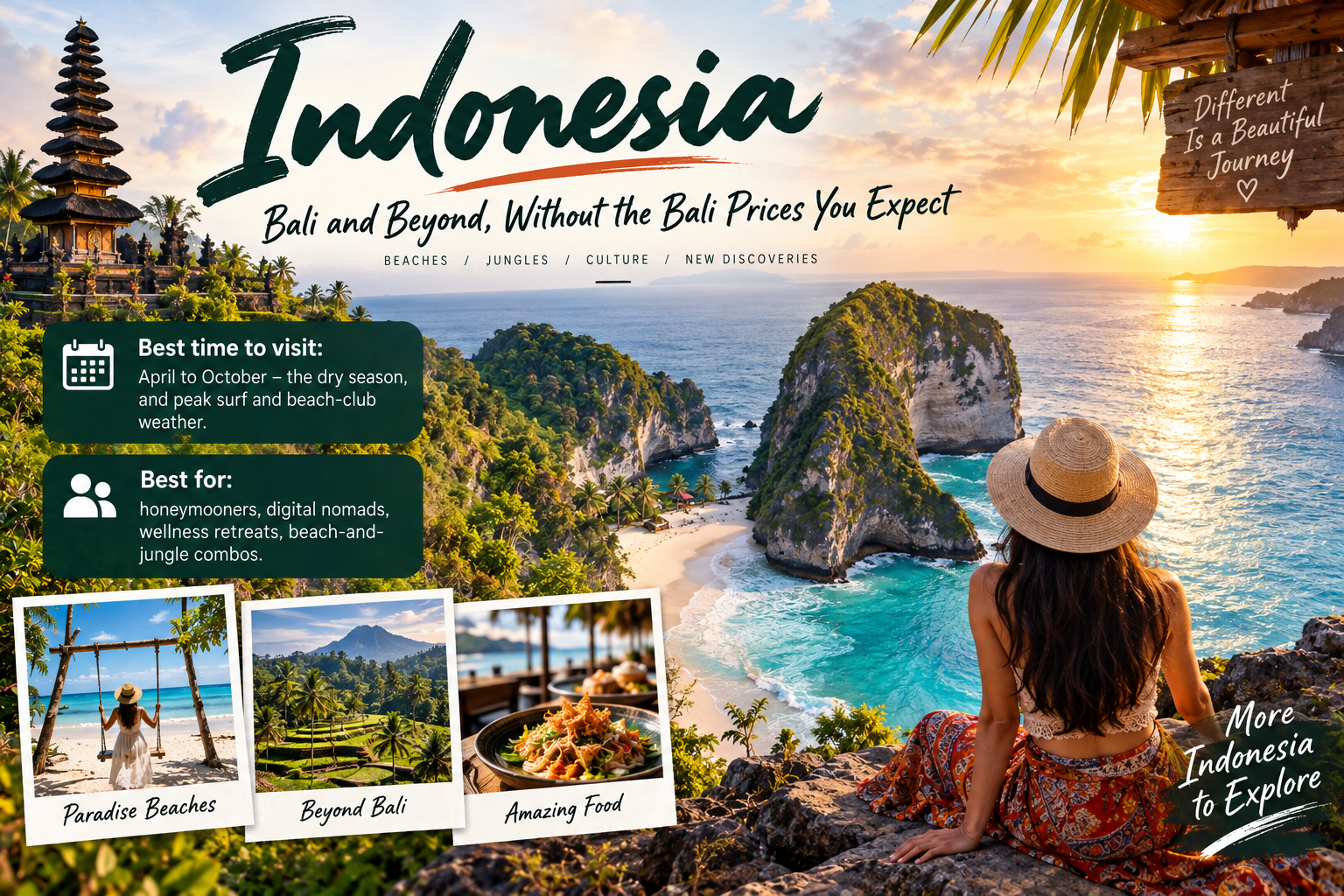
2. Indonesia - Bali and Beyond, Without the Bali Prices You Expect
💱 Currency snapshot: 1 INR ≈ Rp185 Indonesian Rupiah
Everyone assumes Bali is expensive because Instagram made it look premium. In reality, the Indonesian Rupiah is one of the weakest major currencies against the INR - every rupee you carry converts to roughly 185 Rupiah, which means even "splurge" spending in Bali feels reasonable once you do the math.
Villas with private plunge pools in Ubud's rice-terrace belt, beach clubs in Canggu and Uluwatu, and world-class surf breaks are all within reach of a budget that would barely cover three nights in Goa during peak season. A full Balinese meal at a warung (local eatery) can cost under ₹250, and a private driver for a full day of temple-hopping often comes in under ₹2,000.
Indonesia is bigger than Bali too - the Gili Islands for slow, car-free beach days, Lombok for a quieter version of Bali's landscapes, and Yogyakarta for the sunrise-over-Borobudur experience that regularly tops "trip of a lifetime" lists. Flights from major Indian cities to Denpasar (Bali) typically involve one stop via Singapore, Kuala Lumpur, or Jakarta, and a visa-on-arrival is available for Indian travelers.
🛒 What to pack for Indonesia (Bali):
- Waterproof phone pouch - for boat rides to Gili and Nusa Penida, waterfalls, and beach days.
- Foldable beach bag - packs flat on the way there, holds everything on the way to Canggu or Uluwatu.
- Quick-dry travel towel - beach days and island-hopping without a soggy bag afterward.
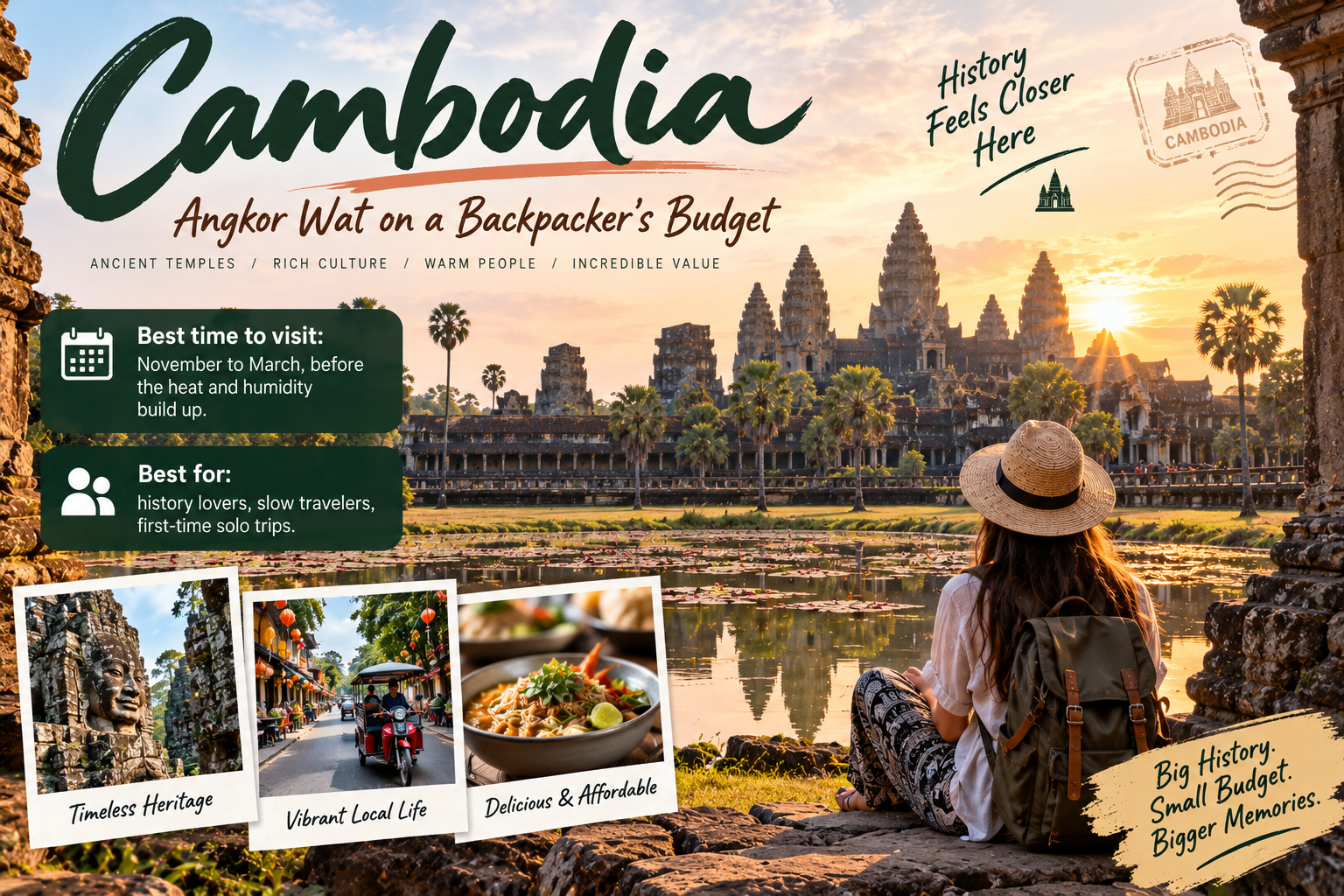
3. Cambodia - Angkor Wat on a Backpacker's Budget
💱 Currency snapshot: 1 INR ≈ ៛42 Cambodian Riel
Cambodia doesn't get nearly enough credit. The country runs largely on US Dollars for bigger transactions (hotels, tours, entry tickets), but the local Riel - where 1 INR converts to roughly 42 Riel - stretches beautifully for everyday spends: street food, tuk-tuk rides, and local markets.
Watching sunrise over Angkor Wat, the largest religious monument on the planet, is one of those "I can't believe I'm actually here" travel moments - and a multi-day Angkor pass plus a local guide still costs a fraction of a comparable heritage experience in Europe. Siem Reap's night markets, Phnom Penh's riverside promenade, and the white-sand calm of Koh Rong island round out a trip that mixes history, food, and beach time without needing a big budget.
Cambodian food is an underrated highlight - fish amok (a coconut curry steamed in banana leaf) and Khmer noodle soups are both cheap and genuinely excellent. Getting there from India usually means a one-stop flight via Bangkok, Kuala Lumpur, or Singapore, and Indian travelers can apply for an e-visa online in advance.
🛒 What to pack for Cambodia:
- Mosquito repellent travel spray - essential for the pre-dawn Angkor Wat sunrise queue and dusk temple visits.
- Moisture-wicking travel clothing set - hours of Angkor temple-hopping in serious heat and humidity.
- Wide-brim sun hat - there's very little shade across the Angkor complex.
4. Laos - The Quiet One Nobody's Talking About Yet
💱 Currency snapshot: 1 INR ≈ ₭233 Lao Kip
Laos is what Southeast Asia felt like before it became a hashtag. The Lao Kip is deeply favorable to the rupee - 1 INR gets you roughly 233 Kip - and because tourism infrastructure here is still developing compared to neighbours like Thailand, prices for stays, food, and local transport remain genuinely, refreshingly low.
Luang Prabang's morning alms-giving ritual (monks walking silently through the streets at sunrise to receive food offerings) is one of the most quietly moving travel experiences in the region, and it costs nothing to witness respectfully. The turquoise pools of the Kuang Si waterfalls, riverside guesthouses along the Mekong for the price of a Mumbai auto ride, and slow boat journeys through misty mountains make Laos feel like a genuine escape rather than a checklist.
Because it sees far fewer tourists than Vietnam or Thailand, Laos rewards travelers who like unhurried mornings over packed itineraries. Getting there from India typically requires a connection via Bangkok, Hanoi, or Kuala Lumpur, and Indian travelers can get a visa-on-arrival at major entry points.

🛒 What to pack for Laos:
- Lightweight trekking daypack - for waterfall hikes around Kuang Si and village walks near Luang Prabang.
- Portable water purifier bottle - tap water isn't reliably safe; this cuts down on plastic bottle spending too.
- Mosquito repellent travel spray - riverside guesthouses and jungle waterfalls mean more bugs than a beach trip.
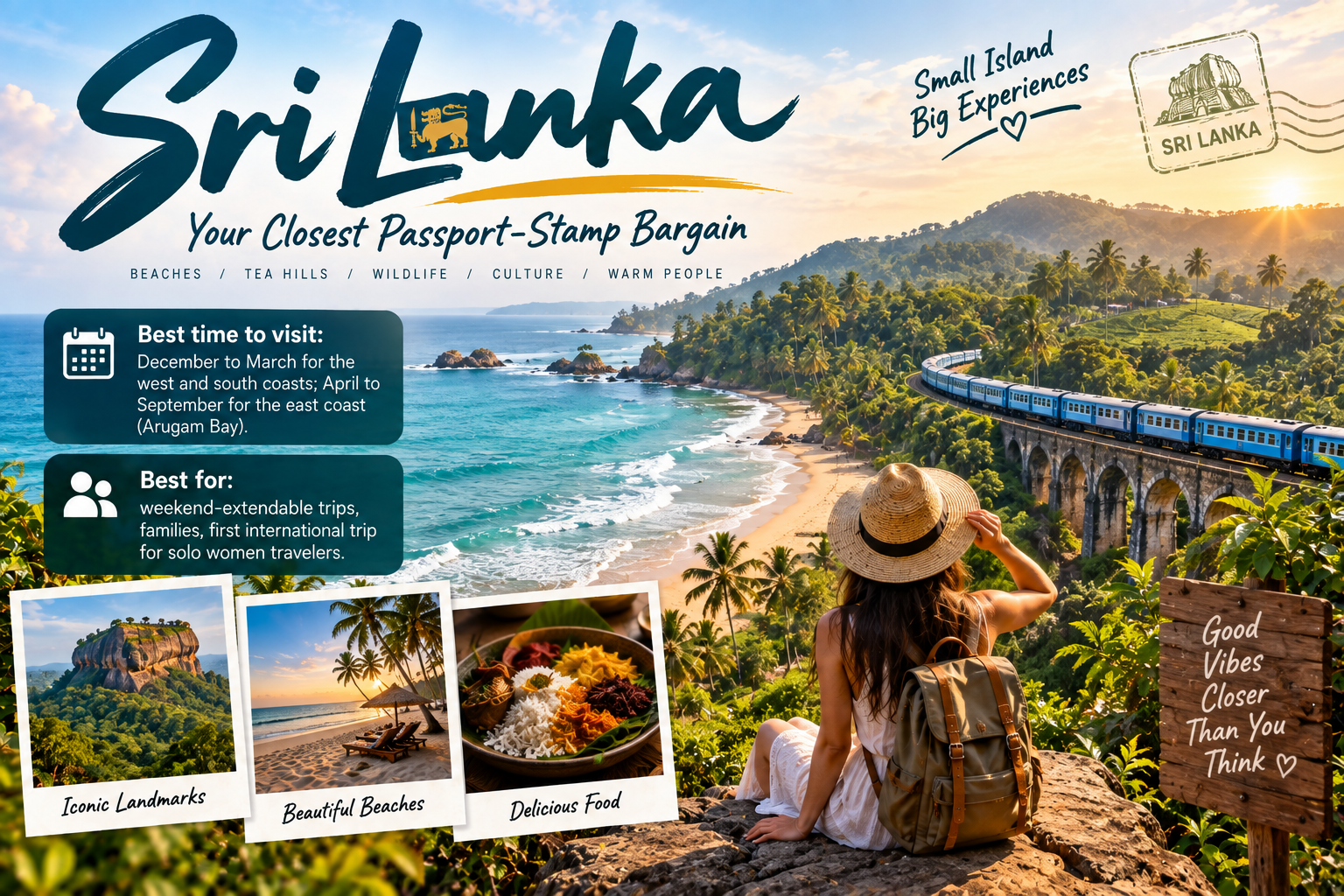
5. Sri Lanka - Your Closest Passport-Stamp Bargain
💱 Currency snapshot: 1 INR ≈ Rs3.4 Sri Lankan Rupee
You don't even need a long flight for this one. Sri Lanka is a short hop from South India - often under 90 minutes from Chennai - and post-economic-shift currency dynamics have made the Sri Lankan Rupee noticeably softer against the INR, with 1 INR now converting to roughly 3.4 Sri Lankan Rupees.
Tea country in Ella (think misty hills, the famous Nine Arch Bridge, and train rides that feel like moving postcards), surf towns like Arugam Bay, ancient cities like Anuradhapura and Sigiriya's rock fortress, and beach stretches from Mirissa to Unawatuna are all within reach on a genuinely modest budget. A full seafood dinner on the coast can cost less than a mid-range meal in an Indian metro, and tuk-tuk travel between towns is cheap enough to not think twice about.
The visa process for Indians is quick - an Electronic Travel Authorization (ETA) that typically takes minutes to process online - and short flight times make Sri Lanka an easy long-weekend trip, not just a full vacation.
🛒 What to pack for Sri Lanka:
- Memory foam travel neck pillow - for the scenic but long hill-country train rides through Ella and Nuwara Eliya.
- Universal travel adapter - Sri Lanka uses UK-style sockets, different from India's standard plugs.
- Reef-safe sunscreen SPF 50 - for the coastal stretch from Mirissa to Arugam Bay.
6. Nepal — Himalayas Without the Financial Altitude
💱 Currency snapshot: 1 INR ≈ Rs1.6 Nepalese Rupee
Nepal has a built-in advantage most travelers forget: the Nepalese Rupee is officially pegged to the Indian Rupee at roughly 1 INR = 1.6 NPR, so there's zero currency-conversion stress - the math never changes, and Indian Rupees (barring ₹2,000 notes) are widely accepted in many places, though carrying some local currency is still smart for smaller towns.
Pokhara's lakeside calm with the Annapurna range reflected in Phewa Lake, Kathmandu's layered temples and chaotic old-town energy, and treks toward Annapurna Base Camp or Poon Hill deliver an experience that feels far more expensive - and far more remote - than it actually is. A multi-day teahouse trek, including basic stays and meals, can cost a fraction of an equivalent guided trek in Europe or South America.
Nepal is also uniquely accessible: no visa is required for Indian citizens, land border crossings are straightforward, and flights from Delhi, Mumbai, Bengaluru, and Kolkata to Kathmandu are short and frequent.

🛒 What to pack for Nepal:
- Waterproof trekking shoes - non-negotiable for any Annapurna or Poon Hill trek.
- Insulated hydration bottle - staying hydrated at altitude matters more than most first-time trekkers expect.
- LED headlamp with extra batteries - teahouses lose power often, and pre-dawn summit starts need hands-free light.
7. Hungary - Affordable Europe, Minus the Schengen Sticker Shock
💱 Currency snapshot: 1 INR ≈ Ft3.3 Hungarian Forint
Western Europe has a well-earned reputation for draining the rupee fast - but Hungary quietly breaks that pattern. The Hungarian Forint converts at roughly 1 INR to 3.3 Forint, and combined with Central Europe's lower cost of living compared to Paris, Amsterdam, or Zurich, it delivers a genuinely "European trip" feeling without the usual budget damage.
Budapest alone justifies the trip: soaking in a centuries-old thermal bath like Széchenyi, walking across the Chain Bridge at night with the Parliament building lit up gold, and eating goulash in a ruin bar carved out of an old building - all at prices that feel closer to a mid-range Indian metro than to Western Europe. Day trips to Lake Balaton or the wine region of Eger add variety without adding much to the budget.
Hungary is part of the Schengen zone, so Indian travelers need a Schengen visa (one visa covers Hungary and most of the EU), but once you're in, the currency advantage keeps stretching your budget the entire trip.

🛒 What to pack for Hungary:
- Lightweight travel jacket - Central European evenings stay cool even in the shoulder seasons.
- Comfortable walking shoes - Budapest's Castle Hill, Chain Bridge, and cobbled old streets are best covered on foot.
- EU-compatible universal adapter - Hungary uses standard European two-pin sockets, different from India's.
8. Kenya - Safari Dreams, Surprisingly Reachable Prices
💱 Currency snapshot: 1 INR ≈ KSh1.35 Kenyan Shilling
Safaris have a reputation for being a "someday, when I'm rich" trip - but Kenya's currency comparison tells a friendlier story. At roughly 1 INR to 1.35 Kenyan Shillings, and with Kenya being one of the most accessible safari destinations from India (direct flights from Mumbai to Nairobi), it's more within reach than most people assume, especially outside peak Great Migration season.
The Maasai Mara's open plains, Amboseli's views of Mount Kilimanjaro across the Kenya-Tanzania border, and Mombasa's palm-lined Indian Ocean coastline give Kenya a genuinely varied trip in one country - wildlife, mountains, and beach, without three separate visas. Budget and mid-range safari camps have become far more common in recent years, meaning a proper Big Five safari no longer requires a luxury-only budget.
Indian travelers can apply for Kenya's eTA (Electronic Travel Authorization) online in advance, and the flight time from Mumbai is comparable to a trip to Southeast Asia.

🛒 What to pack for Kenya:
- Compact travel binoculars - genuinely changes how much you see on a game drive.
- Wide-brim sun hat with UV protection - open-vehicle safari days mean hours of direct sun.
- Insect repellent with DEET - essential for savannah evenings and coastal areas alike.
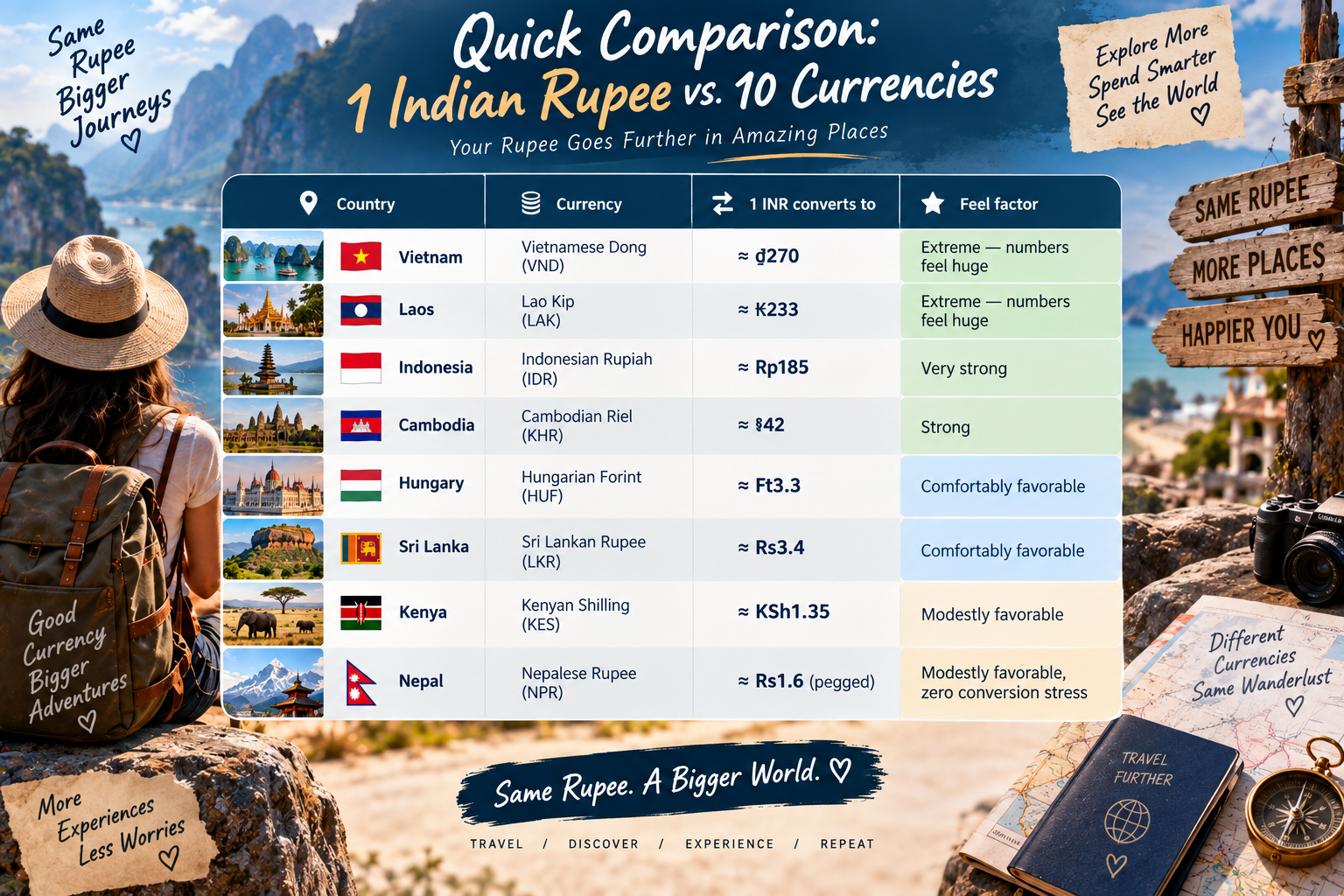
*Rates are indicative as of September 2026 and will shift over time — this table is for quick comparison, not for exchanging money.
Before You Book: The Money Side Most People Get Wrong
Knowing where the rupee is strong is only half the plan. How you carry and spend that money abroad decides whether you actually feel the benefit or lose it to hidden charges.
A few things worth sorting before you fly:
A forex card or multi-currency travel card. Airport currency counters almost always give you the worst rate of your entire trip. Loading a forex card in advance - or using a multi-currency wallet - locks in a better rate and avoids repeated conversion losses. This is genuinely one of the highest-ROI five-minute decisions you'll make before any of these trips.
Travel insurance. It's tempting to skip this when the destination is "cheap," but a single hospital visit in a country you're unfamiliar with can wipe out every rupee you saved on the trip itself. A basic international travel insurance plan usually costs less than one night at your hotel - cheap peace of mind for an expensive mistake to make without it.
A local eSIM. Airport SIM counters overcharge tourists almost everywhere on this list. Grabbing an eSIM before you land means you land already connected - for navigation, translation apps, and calling home - without queueing or getting quoted a "tourist price."
(Forex cards, travel insurance, and eSIMs aren't Amazon-affiliate products, so plug in your own partner links for these three - see the notes in Section 9 below. If you're planning one of these trips through Yatray, we'll also flag the right forex, insurance, and eSIM options for your specific destination as part of your itinerary.)
A Quick Reality Check
None of this means "cheap" should be the only filter for where you travel next. It means that for the same budget you'd spend on a fairly average trip within India during peak season, you could be watching sunrise at Angkor Wat, soaking in a thermal bath in Budapest, or on a game drive in the Maasai Mara.
The rupee doesn't win everywhere. But where it does, it's worth taking full advantage of it - while the exchange rate is in your favor and before the world catches on to these destinations the way it already has to Bali and Vietnam.
Final Thoughts
Currency strength is one of those quiet variables that changes what "possible" looks like on your travel list. A trip that felt out of reach in Europe suddenly feels completely doable in Hungary; a safari that sounded like a "someday" dream turns out to be closer than a long weekend in the Maldives.
The smartest move isn't just picking the cheapest country on this list. It's matching the right value destination to the kind of trip you actually want - ruins and temples, mountains and treks, beaches and villas, safaris, or wine and old towns - and then packing your wallet (and your bag) with the right tools so the savings actually reach your pocket instead of leaking out in fees and last-minute airport purchases.
FAQ
1. Which country has the strongest rupee value compared to India right now? Vietnam currently tops the list, with 1 INR converting to roughly 270 Vietnamese Dong, closely followed by Laos (≈233 Kip) and Indonesia (≈185 Rupiah) - all currencies where the numbers on price tags look dramatically larger than what you're actually spending.
2. Is it actually cheaper to travel to these countries than to travel within India? For mid-range and premium experiences, often yes. Flights and accommodation in destinations like Vietnam, Cambodia, or Laos can undercut equivalent domestic trips in India during peak season, especially when booked a few weeks in advance.
3. Do Indians need a visa for most of these countries? It varies. Nepal requires no visa for Indian citizens; Sri Lanka, Cambodia, Kenya, and Uzbekistan offer e-visas, or Electronic Travel Authorizations, and Hungary (being part of the Schengen zone) requires a Schengen visa. Always check current requirements before booking flights.
4. What's the best way to carry money to these countries? A mix works best: a loaded forex card for the bulk of your spending (better exchange rates, safer than cash), a small amount of local currency or USD for cash-only situations, and a backup international debit card for emergencies.
5. Is Vietnam or Indonesia better for a first-time budget trip from India? Vietnam tends to edge ahead for food-focused, culture-heavy travelers, while Indonesia (especially Bali) suits people wanting a beach-and-wellness mix. Both are excellent, genuinely affordable, and well-connected from major Indian cities.
6. Are these countries safe for solo and women travelers? Sri Lanka, Vietnam, Nepal, and Hungary are generally considered solid choices for solo and women travelers, with well-established tourist infrastructure. As with any international trip, standard precautions and destination-specific research are recommended.
7. When is the best time to visit these value-for-money destinations? It depends on the country - Southeast Asia (Vietnam, Cambodia, Laos, Indonesia) is best in the dry season (roughly November to April), Nepal's trekking seasons are spring and autumn, Central Asia (Uzbekistan, Kazakhstan) is most pleasant in spring or early autumn, Hungary shines in late spring and early autumn, and Kenya's best safari window is July to October.
8. Why does 1 INR convert to such a large number in some countries but not others? It comes down to each country's currency valuation, inflation history, and monetary policy - currencies like the Vietnamese Dong or Lao Kip have historically been issued in larger denominations, while others like the Nepalese Rupee are pegged close to the INR's value. A "big number" conversion doesn't always mean bigger savings - it's the cost of living on the ground that matters most, which is why this guide pairs each currency comparison with real price examples.