Jaipur
The Pink City - UNESCO Royal Heritage, Majestic Hill Forts & Vibrant Bazaars
Jaipur is the royal capital of Rajasthan and a UNESCO World Heritage planned city. Celebrated worldwide as the 'Pink City', it mesmerizes travelers with hilltop fortresses like Amber and Nahargarh, the honeycomb windows of Hawa Mahal, imperial City Palace, Jantar Mantar observatory, and vibrant markets rich in Meenakari jewellery and block-printed textiles.
Overview
Founded in 1727 by the astronomer king Maharaja Sawai Jai Singh II and designed by architect Vidyadhar Bhattacharya, Jaipur is India's first planned grid city and a designated UNESCO World Heritage Site. Painted in a distinctive terracotta pink in 1876 to welcome the Prince of Wales, the city's wide avenues, fortified gates, and uniform pink facades reflect a masterclass in ancient Indian Vastu Shastra urban planning.
Jaipur forms the crown jewel of India's Golden Triangle travel circuit (alongside Delhi and Agra). Its skyline is dominated by formidable hilltop fortresses - Amber Fort with its glittering Sheesh Mahal, Jaigarh Fort housing the world's largest wheeled cannon (Jaivana), and Nahargarh Fort perched on the Aravalli ridges offering sweeping sunset views over the pink urban expanse below.
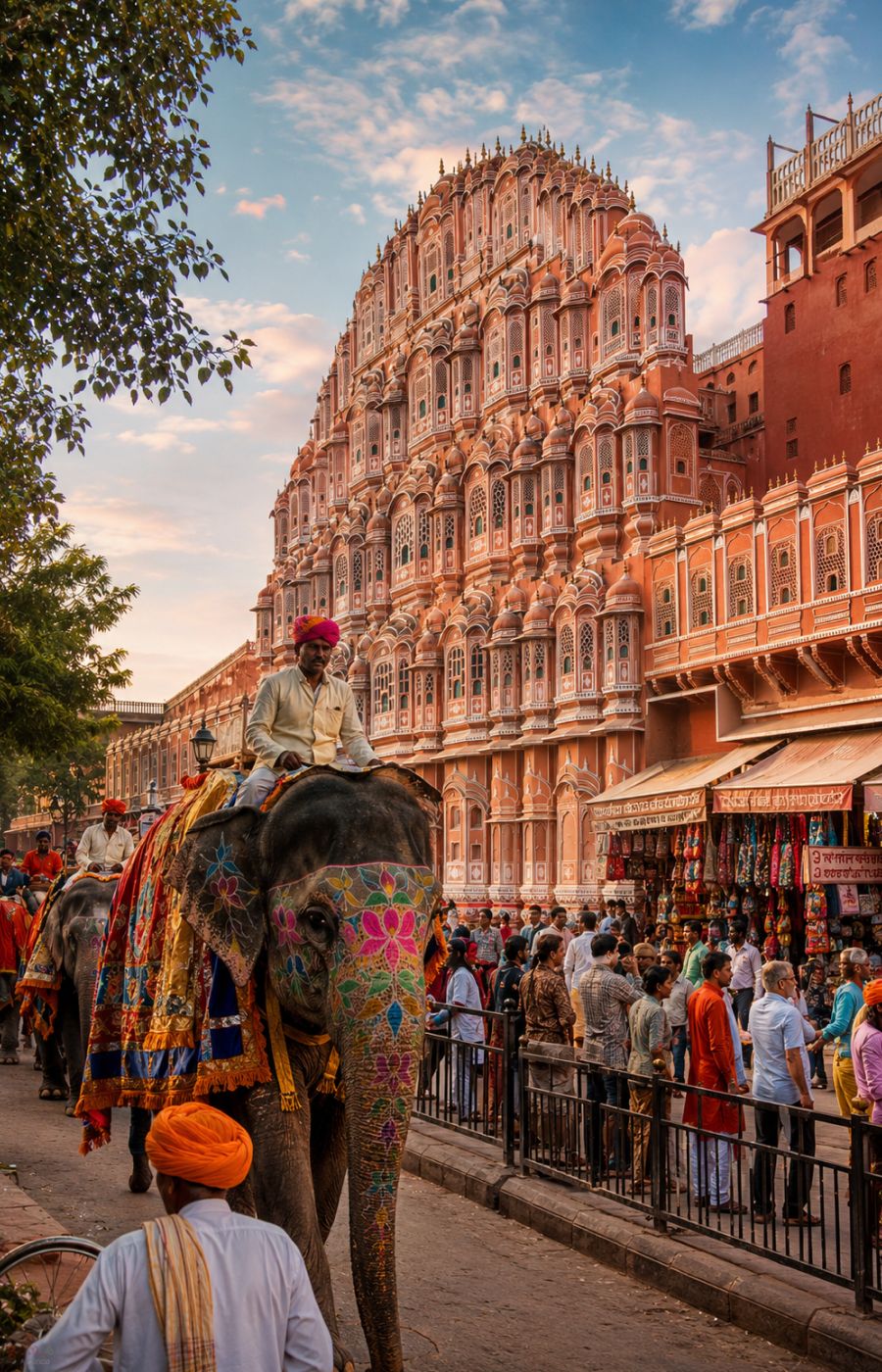
At the heart of the walled city lies the imperial City Palace, the iconic 953-windowed Hawa Mahal (Palace of Winds), and Jantar Mantar - the 18th-century UNESCO World Heritage astronomical observatory containing Samrat Yantra, the world's largest stone sundial. Paired with historic bazaars like Johari and Bapu Bazaar known for gemstone cutting, block printing, and legendary Rajasthani delicacies like Dal Baati Churma and Ghevar, Jaipur presents a grand celebration of royal heritage.
Jaipur, Rajasthan
Map of Jaipur showing Amber Fort, City Palace, Hawa Mahal, Jantar Mantar, and Nahargarh Fort.
Why Visit
- 01
UNESCO Planned Walled City
Wander through 18th-century pink avenues, historic city gates, and symmetrical grid markets built on ancient Vastu principles.
- 02
Amber Fort & Sheesh Mahal
Explore the magnificent hilltop Rajput-Mughal fortress featuring intricate mirror mosaic halls overlooking Maota Lake.
- 03
Hawa Mahal & City Palace
Admire the 953 honeycomb lattice windows of Hawa Mahal and the royal court chambers of City Palace.
- 04
UNESCO Jantar Mantar Observatory
Marvel at 19 giant 18th-century stone astronomical instruments including the world's largest stone sundial.
- 05
Aravalli Fort Sunsets & Bazaars
Watch sunset over the pink skyline from Nahargarh Fort and shop for Kundan jewellery and block prints in Johari Bazaar.
Must-Visit Places
The experiences that define your journey.
- Yatray Place
Amber (Amer) Fort
Constructed by Raja Man Singh I in 1592, Amber Fort showcases a grand fusion of Rajput and Mughal architecture across majestic courtyards like Diwan-i-Aam, Jai Mandir, and Ganesh Pol, set against sweeping views of Maota Lake.
Photo TipCapture the reflection of Amber Fort's yellow sandstone ramparts in the waters of Maota Lake from the lower garden terrace.
Duration: 2 to 3 hoursBest: 8:00 AM to 11:30 AM for cooler temperatures, or 6:30 PM for sound and light show - Yatray Place
Sheesh Mahal (Palace of Mirrors)
Built under Maharaja Jai Singh I, the Sheesh Mahal is a glittering masterpiece of glass mosaic art. Designed so that a single small candle flame reflects across thousands of tiny concave mirror facets, creating the illusion of a starry night sky inside the royal chamber.
Photo TipFocus on the intricate flower motifs and delicate glass mosaic arches framing the central hall, capturing light reflecting off mirror facets.
Duration: 45 minutes to 1 hourBest: 9:00 AM to 12:00 PM for optimal natural light entering the archways - Yatray Place
Hawa Mahal (Palace of Winds)
Designed by Lal Chand Ustad to resemble the crown of Lord Krishna, Hawa Mahal allowed royal women to observe street festivals without being seen. Its honeycomb structure acts as a natural air conditioner, piping cool breeze through narrow corridors.
Photo TipPhotograph the full 953-jharokha facade from across the street at Tattoo Cafe's rooftop terrace during early morning light.
Duration: 1 to 1.5 hoursBest: 8:00 AM to 10:00 AM for soft morning sunlight illuminating the pink facade - Yatray Place
City Palace & Peacock Gate Courtyard
Blends Rajput, Mughal, and European architectural styles across courtyards, gardens, and royal museums. Highlights include Chandra Mahal, Mubarak Mahal textile gallery, massive silver water urns (Gangajali), and Pritam Niwas Chowk featuring four ornate doorways including the famous Peacock Gate.
Photo TipCapture detailed close-up photographs of the vibrant enamel peacock feathers on the Peacock Gate in Pritam Niwas Chowk.
Duration: 2 to 2.5 hoursBest: 9:30 AM to 12:30 PM - Yatray Place
Jantar Mantar UNESCO Observatory
Inscribed as a UNESCO World Heritage Site in 2010, it houses 19 monumental stone astronomical instruments designed to measure time, predict eclipses, and track celestial positions. It features the Vrihat Samrat Yantra - the world's largest stone sundial, accurate to two seconds.
Photo TipFrame the geometric 27-meter high stair structure of Vrihat Samrat Yantra against the bright blue sky.
Duration: 1 to 1.5 hoursBest: 9:00 AM to 11:30 AM for clear shadows on stone instrument dials - Yatray Place
Nahargarh Fort & Sunset Viewpoint
Meaning 'Abode of Tigers', Nahargarh formed a defense ring alongside Amber and Jaigarh. It houses Madhavendra Bhawan (nine identical luxury suites built for queens) and is Jaipur's most celebrated sunset viewpoint overlooking the sprawling city lights below.
Photo TipPosition yourself along the fort wall terrace at dusk to capture the sun setting over the Aravalli ridges with Jaipur's pink city grid glowing below.
Duration: 2 to 2.5 hoursBest: 4:30 PM to 7:00 PM for sunset views and illuminated evening skyline - Yatray Place
Jal Mahal (Water Palace)
Built as a duck-hunting lodge for the Maharaja, Jal Mahal is a five-story architectural marvel where four stories remain submerged underwater when the lake is full. Illuminated at night, it creates a magical mirror image on the tranquil lake surface.
Photo TipCapture the illuminated floating water palace at dusk from the paved lakefront promenade with migratory birds resting on the water.
Duration: 45 minutesBest: 6:30 AM to 8:30 AM or 6:00 PM to 7:30 PM (viewable from lakefront promenade) - Yatray Place
Albert Hall Museum (Central Museum)
Designed by Sir Samuel Swinton Jacob and opened in 1887, the museum exhibits a rare collection of ancient coins, royal portraits, Persian carpets, Egyptian mummies, brassware, and traditional Rajasthani arts. Illuminated dramatically by colorful lights every evening.
Photo TipPhotograph the lit-up Indo-Saracenic stone facade at night when hundreds of pigeons flutter across the courtyard.
Duration: 1.5 to 2 hoursBest: 10:00 AM to 1:00 PM or 7:00 PM to 9:00 PM (night viewing) - Yatray Place
Bhangarh Fort & Historic Ruins
Built by Kachwaha ruler Raja Bhagwant Das in 1573 for his son Madho Singh, Bhangarh offers a fascinating expanse of ruined stone bazaar streets, ancient banyan trees, royal palace remnants, and remarkably preserved stone temples like Gopinath and Someshwar set against the Aravalli hills. Widely celebrated in Indian folklore and popular culture for its mysterious reputation, the site is strictly protected by the Archaeological Survey of India (ASI), which prohibits entry before sunrise and after sunset.
Photo TipPhotograph the stone carvings of Gopinath Temple framed by ancient banyan trees against the rugged Aravalli hill backdrop.
Duration: 2 to 2.5 hours (approx 6 to 7 hours total for round-trip day excursion from Jaipur)Best: 8:30 AM to 1:00 PM for morning daylight exploration before afternoon heat
Best Time To Visit
October to March is the best time to visit Jaipur. The winter weather is crisp, clear, and comfortably cool (15°C to 24°C daytime, 8°C to 12°C night), providing ideal conditions for climbing hilltop fortresses, walking through Old City bazaars, and attending cultural celebrations like the Jaipur Literature Festival and Gangaur.
April to June brings hot summer conditions with daytime temperatures reaching 38°C to 44°C. Outdoor fort exploration between 11:30 AM and 4:00 PM can be exhausting, though early morning monument visits (before 10:00 AM) and evening bazaar walks remain viable alongside discounted luxury hotel tariffs.
July to September marks the monsoon season. Rain showers refresh the surrounding Aravalli hills with vibrant greenery, fill Maota Lake and Man Sagar Lake around Jal Mahal, and bring festive local celebrations like Teej. While occasional downpours may briefly delay outdoor fort photography, monsoon offers a scenic and lush perspective of the Pink City.
- October
- November
- December
- January
- February
- March
- ❄️
Winter Season
Pros / HighlightsCrisp, sunny weather (15°C–24°C daytime, 8°C–12°C night); perfect conditions for exploring forts, walking Old City bazaars, and attending Jaipur Literature Festival.Cons / Trade-offsPeak tourist season bringing higher hotel rates and weekend crowds at Amber Fort and Hawa Mahal. - ☀️
Summer Season
Pros / HighlightsLow hotel tariffs and fewer tourist crowds; clear morning hours for early monument visits; vibrant Gangaur festival celebrations in April.Cons / Trade-offsHigh daytime temperatures reaching 38°C–44°C; outdoor sightseeing is exhausting between 11:30 AM and 4:00 PM. - 🌧️
Monsoon Season
Pros / HighlightsAravalli hills turn lush green; Jal Mahal and Maota Lake fill to capacity; pleasant breezes; festive atmosphere during Teej festival.Cons / Trade-offsHumid conditions; sporadic downpours can briefly delay outdoor fort photography.
Yatray Smart Advice
Visit between October and March for the most comfortable weather, ideal monument exploration, vibrant festival colors, and pleasant Old City bazaar walks.
Recommended Places To Stay
- Yatray Stay Recommendation
RTDC Hotel Teej / Gangaur
Collectorate Circle / MI Road, Jaipur
Best ForFamilies, tour groups, and budget travelers seeking clean, reliable state-run accommodation with spacious AC rooms, green lawns, and travel desk
Estimated Budget₹1,800 to ₹3,800 per night
per night - Yatray Stay Recommendation
Hotel Pearl Palace
Hathroi Fort, Ajmer Road, Jaipur
Best ForFamilies, couples, and international travelers seeking a charming boutique heritage hotel with traditional decor and famous Peacock Rooftop Restaurant
Estimated Budget₹2,000 to ₹4,500 per night
per night - Yatray Stay Recommendation
Shahpura House
Bani Park, Jaipur
Best ForHeritage lovers, couples, and families looking for an authentic 200-year-old Rajput boutique hotel with painted frescoes, pool, and rooftop dining
Estimated Budget₹6,500 to ₹12,000 per night
per night - Yatray Stay Recommendation
Rambagh Palace (Taj Hotels)
Bhawani Singh Road, Jaipur
Best ForLuxury travelers, couples, and royal heritage enthusiasts seeking a world-famous 5-star palace hotel with 47 acres of manicured gardens and fine dining
Estimated Budget₹35,000 to ₹85,000 per night
per night
Founded in 1727 as India's first planned grid city, Jaipur glimmers in terracotta pink with soaring Aravalli fortresses, opulent royal palaces, UNESCO astronomical wonders, and bustling artisan bazaars.
— Yatray Editorial TeamVegetarian Food Guide
Must-Try Specialties
Authentic Dal Baati Churma
The definitive Rajasthani royal meal of baked wheat balls dipped in melted desi ghee, served with five-lentil Panchmel dal and sweet crushed wheat churma.
Gatte ki Sabzi & Missi Roti
Tender gram-flour dumplings simmered in a spiced yogurt-gravel curry, paired with hot mustard-seasoned missi rotis.
Pyaz Kachori & Mawa Kachori
Crisp, flaky deep-fried pastries stuffed with spicy seasoned onions (Pyaz Kachori) or sweetened khoya-nuts dipped in sugar syrup (Mawa Kachori).
Desi Ghee Paneer Ghevar
Disc-shaped honeycomb sweet made of flour and pure ghee, topped with rabri, saffron strands, pistachios, and silver foil; Jaipur's signature festive dessert.
Ker Sangri & Bajre ki Roti
Traditional desert berry and bean stir-fry seasoned with dried red chilies and spices, served with hot millet rotis and fresh white butter.
Mirchi Bada & Spiced Kadhi
Large green chilies stuffed with spiced potato mash, batter-fried crisp and served with tangy Rajasthani kadhi and mint chutney.
Curated Restaurants
Laxmi Mishthan Bhandar (LMB)
Pure Vegetarian Rajasthani Thali, Sweets & Street Snacks
Historic pure vegetarian dining hall in Johari Bazaar operating since 1727, world-famous for Ghevar, Dal Baati Churma thalis, and Pyaz Kachori.
Must Try: Rajasthani Thali, Desi Ghee Ghevar, Pyaz Kachori, Royal Kulfi
Timing: 8:00 AM to 10:30 PM
Average Cost: ₹300 to ₹600 per person
Location: Johari Bazaar, Old City, Jaipur
Family Dining ChoiceRawat Mishthan Bhandar
Pure Vegetarian Rajasthani Snacks & Sweets
Legendary sweet institution near Railway Station road celebrated across India as the pioneer of authentic crisp Pyaz Kachori and Mawa Kachori.
Must Try: Pyaz Kachori, Mawa Kachori, Mirchi Bada, Jalebi
Timing: 6:30 AM to 10:00 PM
Average Cost: ₹150 to ₹300 per person
Location: Station Road, Near Railway Station, Jaipur
Family Dining ChoiceNatraj Dining Hall & Restaurant
Pure Vegetarian Unlimited Rajasthani & Gujarati Thali
Highly popular family dining room on MI Road serving unlimited authentic Rajasthani and Gujarati thalis with quick, traditional hospitality.
Must Try: Unlimited Rajasthani Thali, Dal Baati, Gatte ki Sabzi, Kadhi
Timing: 11:00 AM to 3:30 PM & 7:00 PM to 10:30 PM
Average Cost: ₹250 to ₹450 per person
Location: MI Road, Near Panch Batti, Jaipur
Family Dining ChoiceSurya Mahal (Vegetarian Heritage)
Pure Vegetarian North Indian, Rajasthani Thali & Snacks
Elegant pure vegetarian restaurant on MI Road serving North Indian, Rajasthani thalis, South Indian, and traditional sweets in a comfortable setting.
Must Try: Special Rajasthani Thali, Paneer Butter Masala, Chole Bhature
Timing: 8:00 AM to 11:00 PM
Average Cost: ₹250 to ₹500 per person
Location: MI Road, Central Jaipur
Family Dining Choice
Jain Food Availability
Pure satvik and Jain vegetarian thalis (cooked strictly without onion, garlic, or root vegetables) are widely served at LMB, Natraj, Kanha, and major pure vegetarian thali halls across Jaipur.
👨👩👧👦 Family Dining Notes
Jaipur offers family-friendly dining halls with traditional Rajasthani thalis, pure vegetarian sweet shops, and modern cafes on MI Road and C-Scheme suitable for all generations.
Suggested Itinerary
2-Day Escape
- Day 1
Morning
Arrive in Jaipur by morning via flight or Vande Bharat Express train. Check into your hotel. Start your exploration in the UNESCO Walled City at Hawa Mahal for morning photos of the pink 953-window facade.
Afternoon
Walk to City Palace to tour the royal museums and Peacock Gate courtyard. Continue to Jantar Mantar UNESCO observatory.
Evening
In the evening, explore Johari Bazaar for Meenakari jewellery and enjoy Dal Baati Churma at a traditional restaurant.
- Day 2
Morning
Head early to Amber Fort (11 km north) to explore the Sheesh Mahal and royal courtyards. Visit nearby Jaigarh Fort to see the world's largest wheeled cannon (Jaivana).
Afternoon
On your return, stop by Jal Mahal for photographs. In the late afternoon, drive up to Nahargarh Fort for a breathtaking sunset over the pink city grid.
Evening
End your trip with Pyaz Kachori and Ghevar sweets before departing for Jaipur airport or railway station.
3-Day In-Depth Experience
- Day 1
Morning
Arrive in Jaipur and settle into your hotel. Explore the UNESCO Walled City in the morning - Hawa Mahal, City Palace, and Jantar Mantar.
Afternoon
Have lunch at a classic heritage restaurant on MI Road. In the afternoon, visit Albert Hall Museum in Ram Niwas Garden and explore Bapu Bazaar for block-print textiles and leather Mojaris.
Evening
Dine at a classic pure vegetarian thali restaurant.
- Day 2
Morning
Dedicate the day to Aravalli fortresses. Spend your morning exploring Amber Fort and its mirror palace Sheesh Mahal. Walk the elevated corridor to Jaigarh Fort.
Afternoon
After lunch by Man Sagar Lake overlooking Jal Mahal, drive up to Nahargarh Fort for a spectacular sunset.
Evening
Dine at a rooftop restaurant overlooking illuminated city monuments.
- Day 3
Morning
Visit Govind Dev Ji Temple in the morning for serene prayers. Tour an authentic hand block-printing workshop in Sanganer.
Afternoon
Spend your afternoon shopping in Tripolia and Chandpole bazaars for lac bangles and brassware.
Evening
Enjoy a lavish Rajasthani thali dinner before heading to Jaipur airport or railway station.
Travel Tips
Booking & Finance
- Purchase composite 2-day monument entry tickets at your first stop to save money across Amber Fort, Hawa Mahal, and Jantar Mantar.
Transport & Getting Around
- Use e-rickshaws or walk through Old City bazaars as car traffic and parking are tight in Johari Bazaar.
- Carry a hat, sunglasses, and sunscreen during fort walks as open courtyards receive strong sunlight year-round.
Photography Guidelines
- Hire a round-trip cab for Nahargarh Fort sunset views as booking return transport from the hilltop at night is tough.
General Advice
- Explore Hawa Mahal and City Palace early in the morning (by 8:30 AM) to skip midday heat and tourist crowds.
- Sample authentic Pyaz Kachori at Rawat and Desi Ghee Ghevar at LMB in Johari Bazaar.
How To Reach
- By Air
- Jaipur International Airport (JAI) in Sanganer is located 13 km (~25 to 30 minutes by road) from the central city. It is a major airport connected by daily direct flights to all principal Indian metros (Delhi, Mumbai, Bengaluru, Hyderabad, Kolkata, Ahmedabad) as well as international destinations like Dubai and Bangkok. Pre-paid taxis, app cabs (Uber/Ola), and auto-rickshaws are readily available.
- Nearest Airport: Jaipur International Airport (JAI), Sanganer - approx 13 km (~25 to 30 minutes by road)
- By Rail
- Jaipur Junction (JP) is a major superfast railway hub on the North Western Railway network. It receives high-speed express trains directly from Delhi (Vande Bharat Express, Ajmer Shatabdi - ~3.5 to 4 hours), Mumbai, Agra, Udaipur, Jodhpur, Kolkata, and Ahmedabad. Taxis, auto-rickshaws, and Jaipur Metro connect the station seamlessly to all city zones.
- Nearest Station: Jaipur Junction Railway Station (JP) - central location (~3 km from Old City / MI Road)
- By Road
- Jaipur boasts world-class highway connectivity via 6-lane NH-48 and the Delhi-Jaipur Expressway. Road distances include Delhi (270 km, ~4.5 to 5 hours), Agra (240 km, ~4.5 hours via Golden Triangle route), Ajmer/Pushkar (135 km, ~2.5 hours), Udaipur (390 km, ~6.5 hours), and Ranthambore (160 km, ~3.5 hours). Frequent Deluxe Volvo buses run from ISBT Bikaner House, Delhi.
Route & Transit Tips
- Purchase the composite entry ticket at your first monument counter (valid for 2 days across Amber Fort, Hawa Mahal, Jantar Mantar, Nahargarh Fort, and Albert Hall) to save significant time and money.
- Visit Hawa Mahal and Jantar Mantar early in the morning (by 8:30 AM) to enjoy quiet photography before tour buses arrive.
- Use e-rickshaws or walking to explore narrow Old City bazaar lanes between Bapu Bazaar and Johari Bazaar as car parking is restricted.
- Try authentic Rajasthani sweets like Ghevar and Pyaz Kachori from historic sweet shops like Laxmi Mishthan Bhandar (LMB) or Rawat Mishthan Bhandar.
- Carry sunscreen, sunglasses, and a wide-brimmed hat even during winter months as open fort courtyards receive direct sunlight.
- For sunset at Nahargarh Fort, hire a cab or auto for a round trip as booking return cabs from the hilltop at night can be difficult.
Yatray Travel Partner
Plan Your Journey With Yatray
Let our experts craft a tailored travel experience for you. From securing domestic flight connections and train tickets to booking premium stays and private cabs with professional drivers — let us handle all the details.
Usually replies within a few hours.
Nearby Destinations
- Ajmer & Pushkarapprox 135 km, 2.5 hours by road
Holy city famous for Ajmer Sharif Dargah, sacred Pushkar Lake, and the rare 14th-century Lord Brahma Temple surrounded by desert hills.
- Ranthambore National Park (Sawai Madhopur)approx 160 km, 3.5 hours by road
One of India's premier tiger reserves famous for open jeep safaris around ancient fort ruins and Bengal tiger sightings.
- Abhaneri Stepwell (Chand Baori)approx 95 km, 2 hours by road (en route to Agra)
A 9th-century architectural marvel featuring 3,500 narrow steps arranged in perfect geometric symmetry over 13 stories.
Frequently Asked Questions
October to March is the best time to visit Jaipur. The winter weather is crisp and sunny (15°C–24°C), making it ideal for fort exploration, bazaar walks, and sightseeing.
A 3-day to 4-day trip is ideal to cover Amber Fort, City Palace, Hawa Mahal, Jantar Mantar, Nahargarh sunset, Albert Hall Museum, and historic Old City bazaars.
Jaipur International Airport (JAI) in Sanganer is the nearest airport, located 13 km (~25 to 30 minutes by road) from the central city.
The composite ticket is a discounted pass valid for 2 days across Amber Fort, Hawa Mahal, Jantar Mantar, Nahargarh Fort, and Albert Hall Museum, saving money and queue times.
Jaipur was painted in terracotta pink in 1876 under Maharaja Sawai Ram Singh to welcome the Prince of Wales, a tradition maintained today across the UNESCO Walled City.
Yes, all three forts are located along the northern Aravalli ridge. Amber Fort and Jaigarh are connected by an elevated corridor, while Nahargarh is a 15-minute drive further up.
Early morning (8:00 AM to 10:00 AM) is best when golden sunlight strikes the pink front facade directly from the east.
Yes, Jaipur is a safe, welcoming tourist city with clean heritage hotels, golf cart services at major forts, e-rickshaws, and pure vegetarian dining suitable for all ages.
Jantar Mantar is an 18th-century stone astronomical observatory housing 19 giant instruments built by Sawai Jai Singh II, including Vrihat Samrat Yantra, the world's largest stone sundial.
Famous dishes include Dal Baati Churma, Gatte ki Sabzi, Ker Sangri, Pyaz Kachori, Mirchi Bada, and sweets like Desi Ghee Ghevar and Mawa Kachori.
Popular items in Johari Bazaar and Bapu Bazaar include Kundan-Meenakari jewellery, hand block-printed textiles, Bandhani dupattas, lac bangles, blue pottery, and leather Mojaris.
Delhi is 270 km from Jaipur. The best ways to travel are via Vande Bharat Express / Shatabdi Express trains (~3.5 to 4 hours) or via 6-lane NH-48 (~4.5 to 5 hours).
Yes, satvik and Jain meals (cooked without onion, garlic, or root vegetables) are widely served at LMB, Natraj, Kanha, and major pure vegetarian thali halls across Jaipur.
Yes, Jaipur forms the western corner of India's famous Golden Triangle circuit (Delhi-Agra-Jaipur), easily covered in a 5-to-7 day combined itinerary.
Yatray Recommendation
Our Take, From Experience
Jaipur is best experienced by immersing yourself in both its monumental Aravalli fortresses and the vibrant UNESCO Walled City grid. Rather than rushing between monuments, taking time to explore heritage markets and savour authentic food reveals the true regal essence of Rajasthan.
We recommend allocating 3 to 4 full days to comfortably cover Amber Fort, City Palace, Hawa Mahal, Jantar Mantar, Nahargarh sunset, Albert Hall Museum, and the historic bazaars without feeling rushed.
Purchase the composite 2-day monument ticket at your first attraction counter to save significant time and money across major sight entrances.
Explore Bapu Bazaar and Johari Bazaar on foot or by e-rickshaw, and treat yourself to authentic Dal Baati Churma and Pyaz Kachori at historic establishments like LMB and Rawat.
Combine your Jaipur trip with Delhi and Agra for the iconic Golden Triangle tour, or extend your journey into Rajasthan to visit Ajmer, Pushkar, or Udaipur.
Your Journey Starts Here
Let us craft your perfect
Jaipur itinerary.
Share your dates, travel style, and budget — our concierge team will shape a calm, personalized journey.
Itinerary · Hotels · Flights · Transfers · Local guidance